How High-frequency Transformer Cores Enable Efficient Inverter Power Supplies

Inverter power supplies are at the heart of modern energy conversion systems, from solar inverters and motor drives to UPS units and industrial power equipment. As efficiency requirements become more demanding and system sizes continue to shrink, high-frequency transformer cores play an increasingly critical role.
Unlike traditional low-frequency transformers, high-frequency transformers operate at tens or even hundreds of kilohertz. At these frequencies, transformer core material, magnetic design, and loss characteristics directly determine overall inverter efficiency. This article explores how high-frequency transformer cores enable efficient inverter power supplies, focusing on magnetic behavior, loss reduction, and practical design considerations.
Why High-frequency Operation Improves Inverter Efficiency
Increasing switching frequency allows inverter power supplies to:
- Reduce transformer size and weight
- Improve power density
- Respond faster to load changes
However, higher frequency also increases core loss and thermal stress if the core material is not optimized. This makes the selection of a suitable high-frequency transformer core essential for achieving efficiency gains without sacrificing reliability.
The Role of Core Material in Efficiency
Low Core Loss at High Frequency
Core loss consists mainly of hysteresis loss and eddy current loss. In high-frequency inverter applications, these losses can quickly dominate total power dissipation.
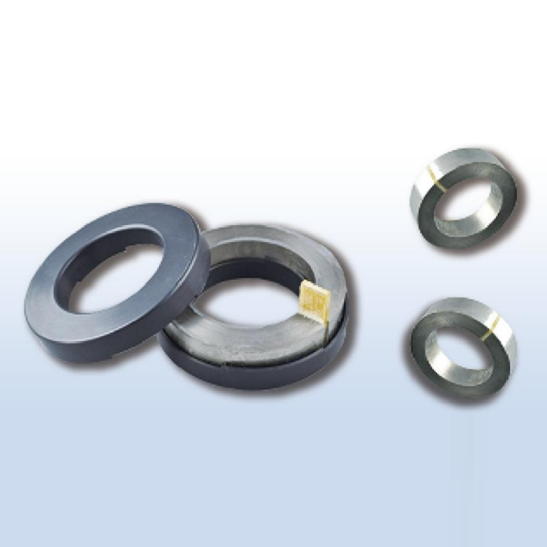
Advanced magnetic materials used in high-frequency transformer cores are designed to:
- Minimize hysteresis loss through optimized magnetic domains
- Reduce eddy current loss via thin laminations or high-resistivity structures
- Maintain stable performance across a wide frequency range
Lower core loss directly translates into higher inverter efficiency and reduced cooling requirements.
Magnetic Flux Control and Saturation Margin
Efficient inverter operation depends on keeping the transformer core within a safe magnetic flux density range. If the core approaches saturation:
- Magnetizing current rises sharply
- Switching losses increase
- System efficiency drops
High-frequency transformer cores are engineered to offer sufficient saturation margin, allowing the inverter to handle transient loads and voltage variations without performance degradation. This stable magnetic behavior supports consistent energy transfer in real-world operating conditions.
Thermal Performance and Heat Management
Thermal behavior is closely linked to efficiency. Excessive core loss generates heat, which not only reduces efficiency but also shortens component lifespan.
Well-designed high-frequency transformer cores help:
- Limit temperature rise under continuous operation
- Maintain magnetic properties at elevated temperatures
- Improve long-term system reliability
By reducing heat generation at the magnetic core level, inverter designers can simplify thermal management and achieve higher overall efficiency.
Impact on Power Density and System Integration
One of the major advantages of using high-frequency transformer cores is improved power density. Higher operating frequency allows smaller core volumes while delivering the same power level.
This enables:
- More compact inverter designs
- Reduced material usage
- Easier integration into space-constrained systems
For applications such as renewable energy inverters and industrial drives, compact size combined with high efficiency is a key competitive advantage.
Design Flexibility for Different Inverter Topologies
Different inverter topologies—such as full-bridge, half-bridge, or resonant converters—place different demands on transformer cores. High-frequency transformer cores provide design flexibility by supporting:
- A wide range of switching frequencies
- Various waveform shapes
- Different power levels
This adaptability allows engineers to optimize efficiency across multiple inverter designs using carefully selected core materials and geometries.
Manufacturing Quality and Performance Consistency
Efficiency gains achieved on paper must be repeatable in production. Consistent core material properties, precise processing, and tight quality control are essential for reliable inverter performance.
Manufacturers like Hall Magnetics focus on stable magnetic characteristics and controlled production processes to ensure that high-frequency transformer cores deliver predictable efficiency benefits across batches and applications.
Conclusion
High-frequency transformer cores are a key enabler of efficient inverter power supplies. By reducing core loss, maintaining stable magnetic behavior, improving thermal performance, and supporting compact designs, they directly contribute to higher energy conversion efficiency.
As inverter applications continue to evolve toward higher power density and stricter efficiency standards, selecting the right high-frequency transformer core becomes a critical design decision. With proper material choice and magnetic design, engineers can unlock the full potential of modern inverter power supplies.